
Jadeite: The Imperial Jade of Exquisite Greens

Jadeite represents the most valued variety of jade in the high-end jewelry market, although nephrite continues to be more widely used globally due to its abundance and more affordable price. This mineral stands out for its extraordinary range of green colors, from subtle tones to intense greens reminiscent of the most lush vegetation. Belonging to the pyroxene group, jadeite has captivated civilizations for millennia, being appreciated not only for its aesthetic beauty but also for its exceptional physical properties. Master sculptors immediately recognize it by its characteristic silky texture and translucency that distinguishes it from other similar minerals.
In Asian cultures, especially Chinese, this precious stone has acquired profound symbolism related to purity, longevity, and prosperity, becoming a family treasure passed down from generation to generation. Its remarkable toughness and polishing ability make it ideal for creating art objects and jewelry, although it should be noted that nephrite possesses superior toughness due to its interwoven fibrous structure. Nephrite has slightly lower hardness (6-6.5 on the Mohs scale), but its fibrous structure gives it even greater toughness. Authentic high-quality jadeite is so prized that collectors pay considerable sums to acquire exceptional specimens.
The Name
The term jadeite derives from the Spanish phrase “piedra de ijada,” which literally means “stone of the flank,” referring to the ancient belief that this stone could cure kidney diseases and other organs in the abdominal area. This denomination originated during the Spanish colonial period, when conquistadors observed how pre-Columbian cultures of Central America used this mineral for ritual and ornamental purposes.
The word “jade” was adopted by the French directly from the Spanish “piedra de ijada.” For centuries, both minerals were known simply as “jade” due to the scientific limitations of the time, as sufficient analytical methods did not exist to distinguish them. It was not until the 19th century that mineralogists managed to scientifically distinguish these two minerals, establishing this gem as an independent species within the pyroxene group.
Important cultural distinction: In Chinese, the term “玉” (yù) was traditionally used to refer to nephrite, which was the jade known for millennia. Jadeite, known as “翡翠” (fěicuì), was introduced from Burma only in the 18th century, subsequently becoming the most valued variety.
Origin
This mineral forms primarily under geological conditions of high pressure and relatively low temperature, typical of tectonic subduction zones where oceanic plates sink beneath continental ones. It is found in specific metamorphic rocks such as jadeitites and eclogites. Although it can be found associated with serpentinites, its geological origin is distinct from these rocks. This metamorphism process transforms original igneous rocks into the characteristic jadeite masses we know today.
The most prestigious and productive deposits are concentrated mainly in Myanmar (formerly Burma), specifically in the Kachin region, where high-quality jadeite known as “imperial jade” is extracted. Although jade (nephrite) has been extracted in Asia since Neolithic times, systematic exploitation of this Burmese gem began in the 18th century, gradually becoming the main source of gem-quality material in the world market.
Guatemala houses the most significant deposits of this mineral in America, where the ancient Maya already used this precious stone to create ceremonial and ornamental objects. There are also minor deposits distributed globally:
| Country/Region | Deposit Characteristics | Quality |
|---|---|---|
| Myanmar (Burma) | Kachin region, “imperial jade” | High gem quality |
| Guatemala | Historic Mayan deposits | Ceremonial and commercial quality |
| Cuba | Minor deposits | Lower quality |
| California (USA) | Limited deposits | Lower quality |
| Japan | Traditional deposits | Variable quality |
| Kazakhstan | Soviet-era deposits | Lower quality |
| Russia | Scattered areas | Generally lower quality |
Applications
Jadeite stands out primarily in the high-end jewelry sector, where superior quality specimens are transformed into bracelets, necklaces, rings, and pendants that can reach very high values. Asian master craftsmen, especially Chinese, have perfected carving and polishing techniques over centuries that enhance the natural beauty of this mineral.
In artistic sculpture, this gem is considered one of the noblest materials for creating figurines, vases, decorative objects, and art pieces preserved in museums worldwide. Its remarkable toughness prevents fractures during the carving process, although its moderate hardness (6.5-7 on the Mohs scale) limits the level of fine detail compared to harder materials like quartz. Nephrite, on the other hand, presents even superior toughness for work requiring greater impact resistance.
Mineralogical collectors especially seek rare specimens with uncommon colorations, such as lavender, pink, yellow, or even blue varieties, caused by different impurities like chromium, iron, and manganese. Its application in religious and ceremonial objects continues to be significant in Asian cultures, where statues, amulets, and ritual objects are created.
Curiosities
One of the most fascinating traditions related to this precious stone is the legend of the Chinese Jade Emperor, an ancient narrative that forms part of cultural folklore about the divine origin of this mineral. These stories reflect the profound cultural reverence for the gem in Asian societies.
In documented historical terms, the most expensive jadeite specimen ever sold was the “Hutton-Mdivani Bracelet,” auctioned by Sotheby’s Hong Kong in 2014 for the record amount of $27.4 million. This exceptional price was due to its extraordinary intense “imperial green” color caused by chromium and its prestigious historical provenance, establishing a record that is not representative of the general market for this gem.
A notable geological curiosity is that jadeite serves as a geological indicator to identify ancient tectonic subduction zones, due to the specific conditions required for its formation. Modern miners combine traditional prospecting techniques with advanced technology, including geological studies, geochemical analyses, and drone prospecting to locate new deposits.

GEM : Jadeite
WEIGHT: 3.65ct
SIZE: 10.9×8.8×4.4mm
SHAPE : Caboixon
COLOR : Green
TREATMENT : no treatment
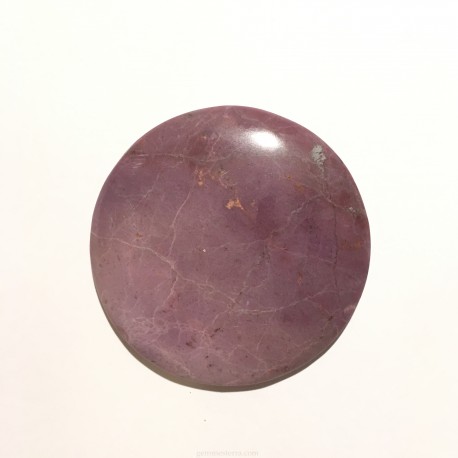
GEM : Jadeite
WEIGHT : 18 g
SIZE: 47 mm
SHAPE : Round
COLOR : Violet
TREATMENT : no treatment

GEM : Jadeite
WEIGHT: 2.90ct
SIZE: 9.3×8.9×4.1mm
FORMA : Rodona
COLOR : Green
TREATMENT : no treatment

GEM : Jadeite
WEIGHT: 8,40ct
SIZE: :15,9x12x4,5mm
FORMA : Oval
COLOR : Green
TREATMENT : no treatment
Characteristics
Chemical
| Property | Description |
|---|---|
| Chemical Composition | NaAlSi₂O₆ (Sodium aluminum silicate) |
| Main Elements | Sodium (Na), aluminum (Al), silicon (Si), and oxygen (O) |
| Trace Elements | Chromium, iron, manganese, and titanium |
| Atomic Structure | Monoclinic crystal system with connected silicon tetrahedra chains |
| Microscopic Structure | Granular with densely packed crystals (different from nephrite’s fibrous structure) |
Physical
| Property | Value/Description |
|---|---|
| Hardness | 6.5-7 on the Mohs scale |
| Toughness | Very good impact resistance (inferior to nephrite) |
| Color | Green (various shades), lavender, pink, yellow, white, blue, black |
| Color Cause | “Imperial” green: chromium; muted greens: iron; lavender: manganese; others: various impurities |
| Luster | Vitreous to pearly, silky on polished surfaces |
| Streak | White |
| Fracture | Conchoidal to uneven |
| Cleavage | Perfect in two directions |
| Specific Gravity | 3.25-3.35 g/cm³ |
| Magnetism | Non-magnetic |
| Conductivity | Electrical insulator |
| Chemical Reactivity | Inert to common acids (natural); may deteriorate if chemically treated |
Treatments and Commercial Classification
It is essential to know the commercial classification of jadeite, especially important for collectors and buyers:
Types by treatment:
| Type | Description | Commercial Value |
|---|---|---|
| Type A | Completely natural jade, without chemical treatments | Most valued |
| Type B | Bleached with acids and impregnated with polymers to improve transparency and color | Reduced value |
| Type C | Artificially dyed to intensify or change color | Much reduced value |
| Type B+C | Combination of bleaching and dyeing | Minimum value |
Common imitations:
| Material | Characteristics | Confusion Risk |
|---|---|---|
| Dyed glass | Uniform color, internal bubbles | High |
| Dyed quartz | Harder, different specific gravity | Medium |
| Painted serpentinite | Surface color, lower hardness | High |
| Other green minerals | Different physical properties | Variable |
Important warning: Treated pieces (Types B and C) can easily deteriorate with household cleaning products, excessive heat, or the passage of time, losing luster and color.
Cultural Significance
| Cultural Aspect | Description | Historical Origin |
|---|---|---|
| Chinese tradition | Symbolisms of wisdom, justice, compassion | Originally associated with nephrite (yù), transferred to jadeite (fěicuì) since the 19th century |
| Ceremonial use | Rituals and symbol of social status | Millennial Asian cultures |
| Family heritage | Ancestral treasure transmitted between generations | Chinese and Asian tradition |
| Religious art | Objects of veneration and meditation | Buddhism and Asian spiritual traditions |
Note: These attributions are part of cultural heritage and traditions, not scientifically verifiable properties.
Final Considerations
Jadeite represents a fascinating mineral from both geological and cultural perspectives. Its formation under specific geological conditions and relative rarity make it a highly appreciated gem in the international market. Its historical importance in Asian cultures, particularly in China, has significantly contributed to its value and prestige.
For collectors and investors, it is important to consider that the market for this precious stone can be volatile and subject to fluctuations. Only specimens of exceptional quality, verified provenance, and without chemical treatments (Type A) consistently maintain or increase their value. Authentication by expert gemologists is essential, given that the market presents high risks of counterfeits, undeclared treatments, and imitations.
Recommendation for buyers: Always request gemological certification from recognized laboratories that specifies the type of jadeite and any applied treatment. This is especially critical in the Asian market, where the distinction between different types can mean value differences of up to 100 times.
This mineral continues to be appreciated both for its intrinsic beauty and its rich cultural heritage, representing a bridge between modern mineralogical science and the millennial traditions that have valued this extraordinary mineral throughout human history.
more minerals…


